Professional Due Diligence
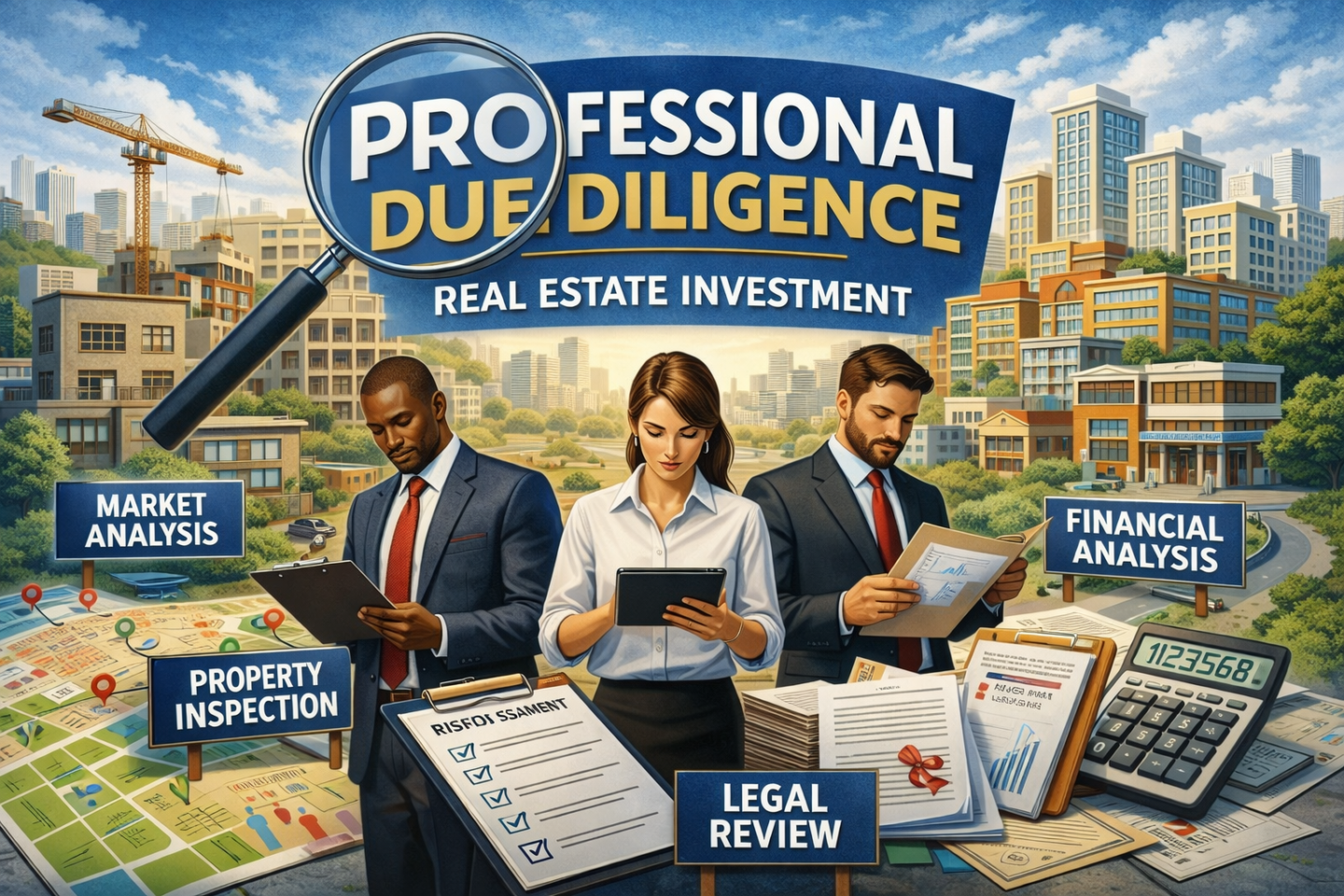
Professional Due Diligence
How Sophisticated Investors Prevent Permanent Capital Impairment
Most real estate losses do not occur because investors misunderstand appreciation potential. They occur because investors underestimate hidden risk.
Due diligence is not a checklist exercise. It is a structured process designed to identify risk that is not obvious in the broker package, pro forma, or offering memorandum. It exists for one reason: to prevent permanent capital impairment.
Between 2025 and 2030, as leverage costs remain elevated and regulatory scrutiny increases, the margin for error in real estate transactions is thinner than it was during the post-2010 expansion. Due diligence must therefore evolve from surface-level inspection to integrated risk analysis.
Sophisticated investors do not ask, “What is this property worth?”
They ask, “What could permanently damage this asset’s value?”
I. Financial Due Diligence: Verifying Income Reality
The first layer of due diligence is financial validation. Pro forma projections are hypothetical. Actual rent rolls and trailing financials are empirical.
Key financial verification includes:
- Trailing 12-month income statements
- Rent roll reconciliation with bank deposits
- Lease audits
- Utility bill review
- Tax assessment review
HUD Fair Market Rent data provides a conservative rent baseline for stress testing.
HUD FMR Dataset:
https://www.huduser.gov/portal/datasets/fmr.html
Meanwhile, income and demographic support should be evaluated using American Community Survey data.
ACS Data Portal:
https://data.census.gov
If current rents materially exceed local income capacity without clear justification, rent risk is embedded in the deal.
Financial diligence is less about upside and more about downside validation.
II. Physical Due Diligence: Systems, Not Cosmetics
The second layer is physical inspection — and this is where many investors misallocate attention.
Cosmetic upgrades are visible. Structural and mechanical systems are not.
Critical inspection areas include:
- Roof age and condition
- HVAC systems
- Electrical panels and wiring
- Plumbing infrastructure
- Foundation integrity
- Drainage and water intrusion
Deferred maintenance compounds over time. A property with aging systems may require capital expenditures that erase projected returns.
Professional inspections and contractor bids are not optional for serious investors.
The goal is not to confirm the property looks acceptable. It is to quantify future capital requirements.
III. Title and Legal Risk
Title defects are rare — but when present, they can be catastrophic.
Title review should confirm:
- Clean chain of ownership
- Absence of undisclosed liens
- Recorded easements
- Access rights
- Survey boundary confirmation
Title insurance mitigates risk but does not replace review.
Additionally, zoning compliance must be verified. Zoning mismatches can invalidate use assumptions.
Zoning research tools such as the National Zoning Atlas can provide initial context.
Zoning Atlas:
https://www.zoningatlas.org
However, municipal code verification is the authoritative source.
Legal due diligence prevents ownership surprises.
IV. Environmental Risk
Environmental issues can permanently impair property value.
Phase I Environmental Site Assessments are common in commercial transactions. These reports identify potential contamination risks such as:
- Underground storage tanks
- Prior industrial use
- Soil contamination
- Asbestos
- Lead-based paint
EPA guidance on environmental site assessments:
https://www.epa.gov/brownfields
Failure to conduct environmental diligence can expose owners to remediation liability that exceeds acquisition cost.
Environmental risk is asymmetric: small probability, large consequence.
V. Insurance and Climate Exposure
Insurance is no longer a stable expense line.
The Insurance Information Institute documents increasing volatility in property insurance premiums, particularly in coastal and wildfire-prone regions.
Insurance Information Institute Data:
https://www.iii.org/fact-statistic/facts-statistics-homeowners-and-renters-insurance
Investors must verify:
- Insurability
- Premium projections
- Coverage exclusions
- Deductible structures
Climate exposure — flood plains, wildfire zones, hurricane paths — must be reviewed using FEMA flood maps and regional hazard data.
FEMA Flood Map Service Center:
https://msc.fema.gov
A property that cannot be insured affordably is not an investment. It is a liability.
VI. Market Due Diligence: Demand Stability
Macro data informs micro performance.
Population trends from the U.S. Census Bureau reveal whether a market is growing or shrinking.
Census Population Estimates:
https://www.census.gov/programs-surveys/popest.html
Employment stability data from the Bureau of Labor Statistics indicates economic resilience.
BLS Local Area Unemployment Statistics:
https://www.bls.gov/lau/
A property in a declining labor market faces structural rent pressure regardless of renovation quality.
Market due diligence contextualizes asset-level risk.
VII. Financing Due Diligence
Debt terms must be reviewed as rigorously as the property itself.
Investors should analyze:
- Loan-to-value ratios
- Debt service coverage ratios
- Rate adjustment clauses
- Prepayment penalties
- Recourse provisions
The Federal Reserve’s Senior Loan Officer Opinion Survey reflects tightening or loosening lending standards.
Federal Reserve SLOOS:
https://www.federalreserve.gov/data/sloos.htm
If financing assumptions are fragile, the asset becomes fragile.
VIII. Partnership and Governance Risk
If investing with partners, due diligence must extend to the people involved.
This includes:
- Sponsor track record
- Litigation history
- Financial transparency
- Capital call provisions
- Exit mechanisms
Many investment failures stem not from asset performance but from governance breakdown.
Partnership due diligence is risk mitigation at the human level.
IX. The Red Flag Framework
Professional investors look for patterns, not isolated issues.
Red flags include:
- Inconsistent financial statements
- Reluctance to provide documentation
- Unusual vacancy explanations
- Excessive pro forma rent growth assumptions
- Short due diligence timelines imposed by sellers
Speed should never replace scrutiny.
X. The Due Diligence Mindset
Between 2025 and 2030, volatility — in rates, regulation, climate, and supply — increases the cost of mistakes.
Due diligence is not about proving the deal works. It is about stress testing whether it survives.
Sophisticated investors assume:
- Renovations cost more
- Lease-up takes longer
- Insurance increases
- Regulation tightens
If the deal survives those assumptions, it deserves capital.
DATA APPENDIX — PROFESSIONAL DUE DILIGENCE
A. Rent Benchmarks
HUD Fair Market Rents
https://www.huduser.gov/portal/datasets/fmr.html
Supports:
Conservative rent validation.
B. Income & Demographics
American Community Survey
https://data.census.gov
Supports:
Income support for rent projections.
C. Population Trends
U.S. Census Population Estimates
https://www.census.gov/programs-surveys/popest.html
Supports:
Market growth analysis.
D. Employment Data
Bureau of Labor Statistics
https://www.bls.gov/lau/
Supports:
Labor market stability.
E. Lending Conditions
Federal Reserve – SLOOS
https://www.federalreserve.gov/data/sloos.htm
Supports:
Financing risk.
F. Insurance Risk
Insurance Information Institute
https://www.iii.org/fact-statistic/facts-statistics-homeowners-and-renters-insurance
Supports:
Premium volatility trends.
G. Environmental Due Diligence
EPA Brownfields & Environmental Assessment Guidance
https://www.epa.gov/brownfields
Supports:
Phase I ESA framework.
H. Flood Risk
FEMA Flood Map Service Center
https://msc.fema.gov
Supports:
Flood zone exposure.
Closing Perspective
Due diligence is not glamorous. It does not create value. It protects value.
The investors who compound wealth over decades are not those who chase optimistic projections. They are those who avoid permanent loss.
In real estate, discipline is not optional. It is defensive architecture.